 English
 Italian

How Modern Electroplating Reduces Contact Resistance and Extends Busbar Reliability
Power Distribution Trends and Surface Finishing Needs
The rapid global expansion of data centers, AI infrastructure, electrified transportation, and renewable energy systems has created unprecedented demand for high-performance power distribution components. Electrical busbars and connectors must deliver high current densities with minimal electrical losses, while maintaining long-term reliability under thermal, mechanical, and environmental stress. Tin and silver coatings are widely used to enhance the surface properties of copper and aluminum busbars, providing improved conductivity, corrosion resistance, and contact stability.
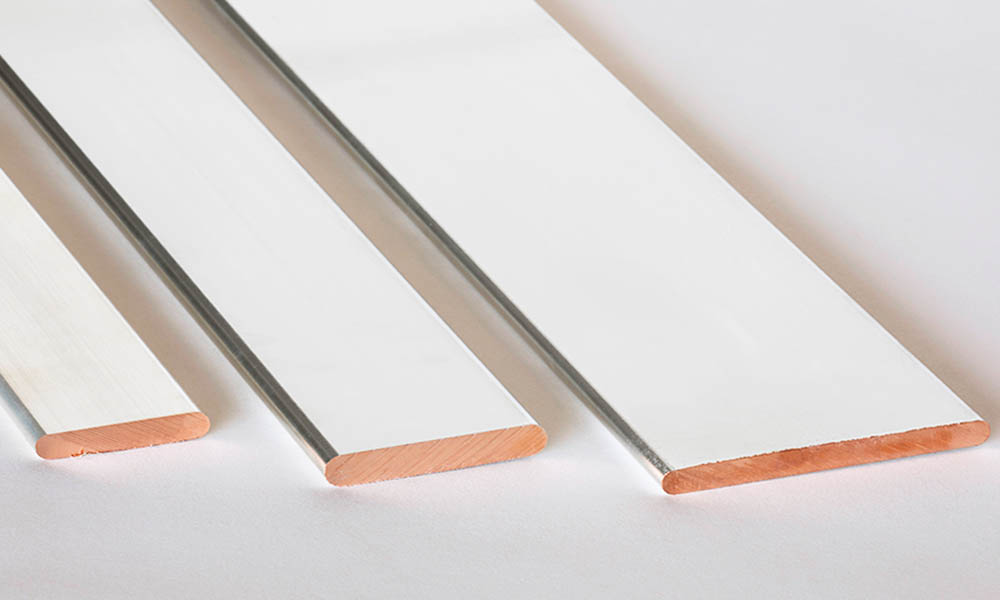
This article presents a comprehensive review of busbar substrate materials, electroplating chemistries, equipment platforms, and post-treatment technologies. Particular emphasis is placed on the industry transition from traditional cyanide-based silver plating chemistries to non-cyanide alternatives, and the critical role of electrolytic anti-tarnish treatments in preserving low contact resistance during storage and service.
Busbar Surface Finishing Requirements
As computing density and electrification levels increase, busbars are required to carry higher currents within increasingly compact envelopes.
Under these conditions, surface-related phenomena such as contact resistance, corrosion, and thermal stability become critical design considerations that directly impact system efficiency and reliability.
At the same time, tightening environmental and workplace regulations are driving the surface finishing industry toward safer, more sustainable electroplating chemistries and higher levels of process automation.
Technic's product line for busbars has been designed to address these challenges, supporting every stage of busbar manufacturing. Tin plating provides corrosion resistance, solderability, and cost effectiveness, while silver plating offers the lowest contact resistance of any engineering metal along with excellent electrical and thermal conductivity.
Busbar Substrate Materials
Copper and aluminum are the two dominant substrate materials used for electrical busbars (see Table 1). Copper busbars are preferred in applications requiring maximum electrical conductivity, compact design, and excellent thermal performance, including data centers, AI infrastructure, EV power electronics, and switchgear. Aluminum busbars offer lower density and material cost advantages and are commonly used in building power distribution systems, utility infrastructure, and large industrial equipment.

From a surface finishing perspective, copper can be directly electroplated following conventional cleaning and activation processes. Aluminum, by contrast, forms a dense, electrically insulating oxide layer immediately upon exposure to air and therefore requires a metallization process prior to electroplating.
Electroplating Chemistries and Processes
Electroplating processes for tin and silver busbars vary depending on substrate material, desired coating thickness, and performance requirements. Process selection directly influences deposit morphology, throwing power, contact resistance, corrosion behavior, and long-term reliability. For aluminum substrates, metallization is most commonly achieved using a zincate process, which deposits a thin zinc layer that enables subsequent electroplating. In select applications where tin is the final finish, immersion tin may be used; however, this approach is not suitable for silver plating.
Tin electroplating for busbars typically employs fully acidic electrolytes with pH values below 1. These systems provide uniform, bright deposits across a wide current density range and can produce coating thicknesses generally between 5 and 15 μm. Key performance attributes include consistent deposition rate, uniform appearance, low and stable contact resistance, and long-term solution stability.
Silver electroplating is typically performed using alkaline electrolytes with pH values above 11. For busbar applications, coating thicknesses generally range from approximately 2.5 to 5 μm. Silver offers the highest electrical conductivity of any engineering metal and does not form insulating surface oxides. Historically, most commercial silver plating processes have relied on cyanide-containing electrolytes. However, cyanide is extremely toxic and poses significant environmental and health risks. Advanced non-cyanide silver electroplating chemistries now provide equivalent performance while significantly reducing safety risks.
Silver Tarnishing and Anti-Tarnish Technologies
Silver's principal vulnerability is its reactivity with sulfur. Silver tarnishing occurs through reaction with sulfur-containing species such as hydrogen sulfide, forming silver sulfide (Ag₂S):
2 Ag + H₂S → Ag₂S + H₂
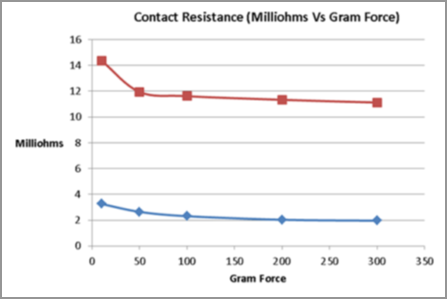
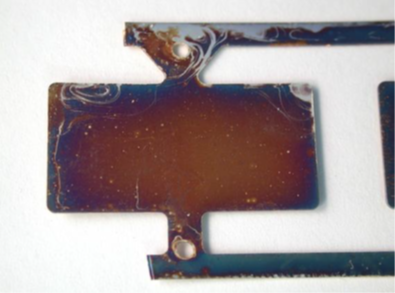
The resulting film ranges from a faint yellow haze to the dark brown-black layer shown in Fig. 1, and because Ag₂S is a poor electrical conductor, its growth directly raises contact resistance (Fig. 2). Unlike a passivating oxide, the sulfide layer is not self-limiting: it continues to thicken with exposure, and elevated temperature and humidity accelerate its formation.
Electrolytic anti-tarnish treatments counter this by depositing a combined organic–inorganic barrier on the silver surface, protecting it against both sulfur exposure and elevated-temperature aging.
Comparative Performance of Cyanide and Non-Cyanide Silver Systems
Accelerated steam aging and ASTM contact resistance testing confirmed the performance of the non-cyanide chemistry. As plated, the cyanide-free silver deposit showed marginally lower contact resistance than the cyanide-based control (see Table 2).

The advantage increased with aging: after 8 hours of steam exposure, the cyanide-free deposit with electrolytic anti-tarnish measured 5.02 m-ohms versus 7.83 m-ohms for the cyanide sample — roughly one third lower.
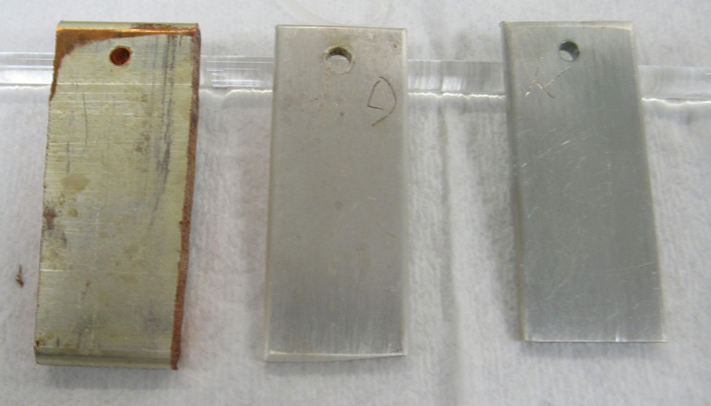
The visual results mirror the performance data (Fig. 3): after 8 hours of steam aging, the cyanide-plated sample (left) shows heavy discoloration, the untreated cyanide-free sample (center) has mild dulling, and the anti-tarnish-treated sample (right) remains bright.
Notably, the anti-tarnish treatment provided most of its benefit under aged conditions, indicating improved long-term stability of the contact surface rather than merely a better initial finish.
Busbar Electroplating Equipment Technologies 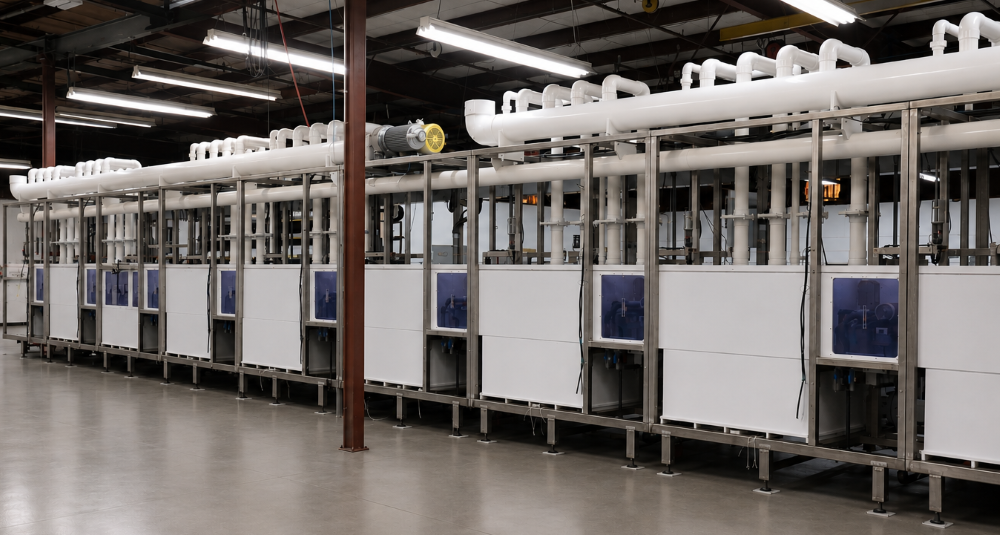
Deposit performance is only half of the equation; the method by which busbars are plated has an equally significant impact on consistency, throughput, and cost.
Manual rack plating remains widely used due to its flexibility and low capital cost, but it is labor-intensive and subject to operator variability. Automated high-speed bar-to-bar plating systems improve throughput and uniformity, while reducing operator exposure.
You can learn more about Technic's plating lines for busbar applications here.
Conclusions
Tin and silver electroplating remain essential technologies for modern power distribution. Tin is the cost-effective choice for corrosion protection and solderability, while silver delivers the lowest contact resistance of any engineering metal.
The results presented here show that Technic's non-cyanide silver chemistry matches the cyanide-based control as plated and outperformed it after accelerated aging; combined with an electrolytic anti-tarnish treatment, it reduced contact resistance after 8 hours of steam exposure by approximately one third.
For busbar manufacturers, the practical implication is that eliminating cyanide no longer costs performance, and pairing these chemistries with automated bar-to-bar processing adds consistency and throughput while reducing operator exposure.
As data centers, AI infrastructure, and electrification push current densities higher, the combination of advanced chemistry, post-treatments, and automated equipment offers a direct path to lower contact resistance and longer busbar service life.
Author

Rob Schetty is the VP of Technology, Sales, and Marketing at Technic.
References
Surface Engineering of Aluminum and Aluminum Alloys, July 7, 2007
Internal Technic research, Technic ATD, 111 E. Ames Ct, Plainview NY 11803 USA


Aggiungi un commento